


Before you start. Unlike prescription medications, dietary supplements are not reviewed by the FDA before they reach store shelves. There is no guarantee that the bottle contains what the label claims, that the dose is consistent, or that the product is free of contaminants. The same goes for peptides and other "wellness" compounds sold online — most have minimal or no human safety data. The recommendations below are based on published clinical evidence, not marketing.
Prostate Cancer

Supplements
No supplement has been proven to prevent prostate cancer or slow its progression on active surveillance, and a few have been shown to make things worse. The SELECT trial (35,000+ men) found that vitamin E raised prostate cancer risk by 17%. Selenium showed no benefit and may increase risk of high-grade disease. Lycopene supplements have not panned out in trials, though tomato-based foods are fine.
Lifestyle
Exercise is the most consistent factor. Men in the highest activity tier have a 25–30% lower risk of advanced or lethal prostate cancer. After diagnosis, regular activity is associated with a 30%+ reduction in prostate cancer-specific mortality.
-
Vigorous aerobic exercise several times per week
-
Mediterranean or plant-based eating pattern — vegetables, fruit, whole grains, fish, olive oil; less red/processed meat
-
Weight loss if overweight (improves metabolic markers tied to progression)
Benign prostatic hyperplasia (BPH)
Supplements
No supplement has solid evidence for BPH. Saw palmetto is the most studied — and the highest-quality trials (CAMUS, 2023 Cochrane) show it works no better than placebo, even at three times the standard dose. Beta-sitosterol, pygeum, and bee pollen have older positive studies, but data are small, dated, and unreliable.
Lifestyle
These won't shrink your prostate, but they can meaningfully reduce symptom burden — often before medication is needed:
-
Limit fluids 2–3 hours before bed to reduce nighttime urination
-
Cut caffeine and alcohol, especially in the evening
-
Avoid OTC decongestants and sedating antihistamines (pseudoephedrine, diphenhydramine) — they tighten the bladder neck
-
Treat constipation — a full rectum compresses the prostate
-
Lose weight if overweight; BPH severity tracks with obesity
-
Stay aerobically active — regular exercise correlates with milder symptoms

Erectile dysfunction (ED)
Supplements
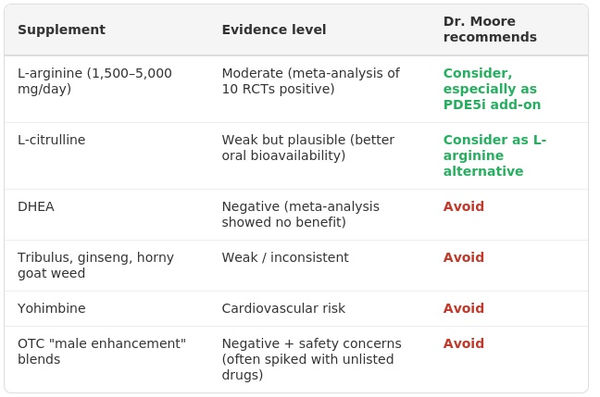
A systematic review of popular OTC ED supplements found that 68% of ingredients had contradicting, negative, or absent data. The cleanest exception is L-arginine (1,500–5,000 mg/day), which has reasonable evidence for mild-to-moderate ED, especially added to a PDE5 inhibitor (Viagra, Cialis). It works through the nitric oxide pathway — the same pathway those medications enhance. L-citrulline is a precursor with better absorption and a reasonable alternative. DHEA, tribulus, ginseng, and horny goat weed lack credible evidence. Yohimbine should be avoided — cardiovascular side effects. Generic "male enhancement" blends sold at gas stations are frequently spiked with unlisted PDE5 inhibitors.
Lifestyle
Aerobic exercise has the strongest evidence of any ED treatment short of medication. Multiple RCTs show meaningful improvement with a dose-response — more exercise, bigger benefit. Effect size is comparable to testosterone therapy in some analyses.
-
Moderate-to-vigorous aerobic exercise (strongest evidence from multiple RCTs)
-
Mediterranean or plant-based diet — 22% lower ED risk in men under 60
-
Weight loss if overweight (RCT evidence for improved erectile function)
-
Smoking cessation — improves erectile function measurably
Prostate Cancer
Supplements
No supplement has been proven to prevent prostate cancer or slow its progression on active surveillance, and a few have been shown to make things worse. The SELECT trial (35,000+ men) found that vitamin E raised prostate cancer risk by 17%. Selenium showed no benefit and may increase risk of high-grade disease. Lycopene supplements have not panned out in trials, though tomato-based foods are fine.
Lifestyle
Exercise is the most consistent factor. Men in the highest activity tier have a 25–30% lower risk of advanced or lethal prostate cancer. After diagnosis, regular activity is associated with a 30%+ reduction in prostate cancer-specific mortality.
-
Vigorous aerobic exercise several times per week
-
Mediterranean or plant-based eating pattern — vegetables, fruit, whole grains, fish, olive oil; less red/processed meat
-
Weight loss if overweight (improves metabolic markers tied to progression)
Recurrent UTIs

Supplements
This is the only condition of these four where supplements have a real evidence base. Cranberry products have the strongest data — a 2023 Cochrane review of 50 trials found they probably reduce recurrent UTI risk, and a 2025 trial showed 500 mg/day of whole cranberry powder cut culture-confirmed UTI risk in half. The AUA supports cranberry prophylaxis. D-mannose blocks E. coli from sticking to the bladder wall and has promising meta-analysis data. Lactobacillus probiotics also have RCT evidence.
Lifestyle
Lifestyle
-
Increase water intake to ~2.5 L/day (RCT evidence for cutting recurrence)
-
Don't hold it — empty your bladder every 3–4 hours
-
Void after intercourse
-
Wipe front to back
-
Avoid spermicides (including spermicide-coated condoms) — they disrupt protective vaginal flora
-
Postmenopausal women: ask about vaginal estrogen — strongest non-antibiotic evidence in this group; not the same as systemic HRT
-
Treat chronic constipation if contributing
-
Don't default to chronic antibiotic prophylaxis — ask about a structured prevention plan first